
Reflections on the Future of Ashtanga Yoga
Many people associate Ashtanga Yoga with the city of Mysore and the Jois family. The passing of Sharath Jois in November 2024 has raised questions about the future of the practice. In this tradition, the guru–śiṣya (teacher–student) relationship is central, along with discipline and a strict adherence to the traditional Ashtanga sequences.
For some, this approach can be challenging. That’s why Sharath created what he called the "Active Series" — a simplified combination of poses from the Primary and Intermediate Series. He introduced it for the first time on November 8, 2024, at the University of Virginia (UVA). His daughter, Shraddha Jois, is now carrying this work forward.
Authorized and Independent Teachers
For Sharath, it was very important that those teaching Ashtanga Yoga were officially authorized by him. I believe this makes sense, as it fosters a sense of connection within the global community tied to the Mysore school. However, this approach can also be somewhat controversial, as it evokes associations with religion or even cult-like structures — with rituals, symbols, and the central figure of the guru.
One such teacher was my beloved mentor, Rolf Naujokat, who passed away on July 8, 2024 — like many other incredible teachers with deep knowledge and experience. Those connected to the older Mysore tradition — and their students — have in some ways created their own branch of Ashtanga Yoga. This style often emphasizes more fluidity, openness, and a less rigid teacher–student dynamic. Practitioners in this tradition may avoid classes with authorized teachers out of concern about judgment or overly strict discipline.
It’s also worth mentioning Manju Jois, the son of Pattabhi Jois, who has been teaching around the world for many years — both in the traditional style and with a gentler approach. His daughter, Sathu Jois, is also teaching and is increasingly seen as a significant figure in the future of the Ashtanga tradition.
Of course, it’s important to say that among the authorized teachers, there are those who are seeking new ways of teaching and offering a softer approach. For many, the clear structure and unchanging discipline of traditional Ashtanga is precisely what they value. I think it’s wonderful that today we have the freedom to choose what suits us best.
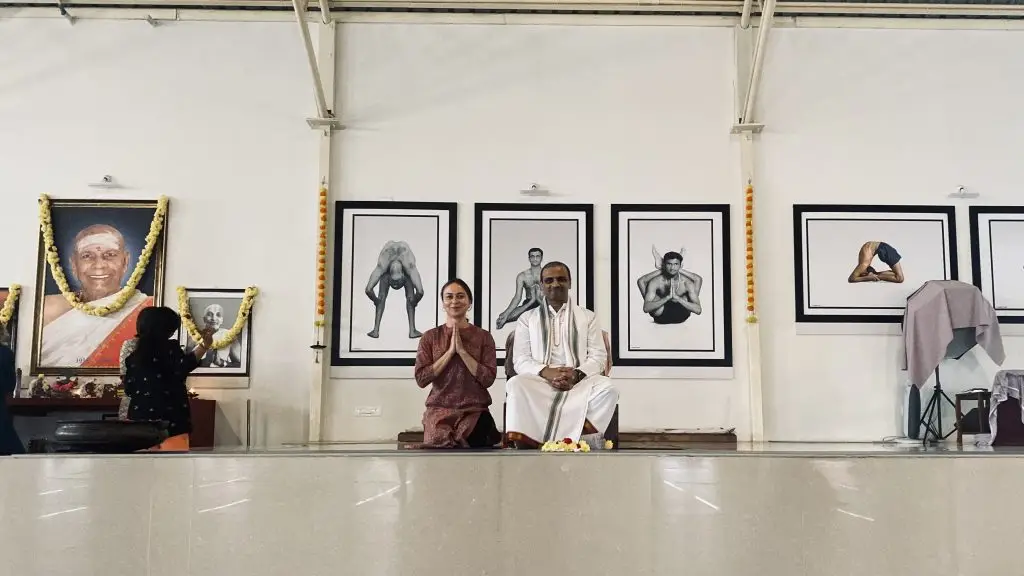
For many years, I found myself caught between these two approaches — unsure of which path to take. I think I always resonated more with the style of the older Ashtanga veterans, but felt that I should be authorized according to Sharath’s school and its established tradition. That’s why I traveled to Mysore four times in total, each for several months. I was never authorized — and now I believe that was the right outcome, that it was meant to be that way. I’ve come to see how valuable that time in Mysore was for me: practicing alongside people for whom Ashtanga is a meaningful path, being in the space Sharath created for us, and having the chance to attend his conferences where he shared his knowledge. I learned so much there.
My Practice Today
These days, I find that I prefer a more personal approach to my practice. I don’t want to confine myself to rigid structures. The passing of both Rolf and Sharath also marks, at least for now, the end of my travels to India. In a way, this has brought me to a place of self-practice — a practice just for me.
I’m not looking for a new teacher, but from time to time I attend workshops led by long-time practitioners with deep experience. What matters most to me is that they are kind and supportive. A good teacher can recognize a student’s needs, see their potential, and adapt the practice accordingly.
I don’t believe that Ashtanga is something I could replace with another method. This is my path. But I’m grateful that I no longer feel bound by dogma. I feel that my practice is deepening with each passing day, and it brings me more and more joy.


 EN
EN  PL
PL